
Forty minutes of solving equations. Following each step, starting to feel it click. Then it’s time for test prep, and the problem on the screen doesn’t look like anything from that lesson.
The wording is unfamiliar, the question format looks nothing like the day’s practice, and the whole thing seems pitched to an older grade. Sometimes it even leans on a foundational skill the class hasn’t reached yet. The read is instant: this isn’t mine to solve.
It’s Not About Ability
The gap isn’t ability. It’s context. Most test prep exists as a separate pathway: a different program, a different sequence, and a different set of topics from what is happening in the classroom that day. Students are asked to switch gears without a warm-up or a connection to what they already know, so unfamiliar material reads as “too hard,” even when it isn’t.
When preparation is embedded directly into the lesson, test-taking strategies can be introduced alongside the course content that makes them useful.
What Changes When Test Prep Lives in the Lesson?
When test prep lives inside the lesson, a few things shift:
- Students have an entry point. They recognize the content, so they can focus on applying a strategy instead of making sense of a brand-new topic.
- Strategies show up when they matter. A math teacher can model eliminating unreasonable answer choices during a relevant problem. An ELA teacher can reinforce evidence selection while students are already analyzing a course-aligned text.
- Teachers work from one connected plan. They spend less time juggling a separate program, sequence, and set of data, and they can see student misconceptions in context, making grouping and reteaching decisions more straightforward.
How ChalkTalk Makes the Match
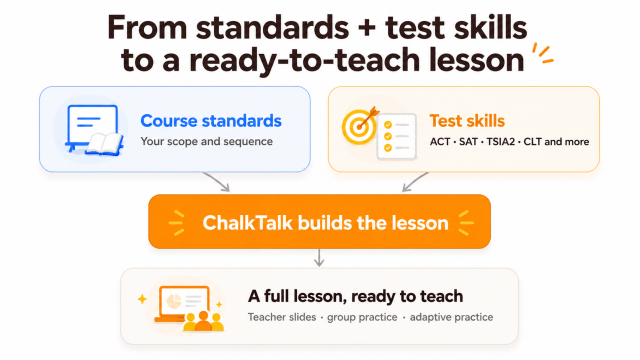
Here is the part that saves the most time: ChalkTalk has detailed lessons, teacher slides, group practice, and adaptive practice to meet your students where they are. We take your course standards and scope and sequences, map them against the skills assessed on the test you choose, whether that is the ACT, SAT or CLT, and create a comprehensive pacing guide that aligns with what is already being taught in the classroom. Course needs and test needs stop being two separate jobs. You get everything you need to teach the required content and the tested skills together, with no lift to align them.
Not One-Size-Fits-All
Embedding test prep does not mean every student needs the same practice at the same moment. Adaptive practice can keep the course content as the anchor while calibrating the work to each student’s level. Students who need prerequisite support can get it, including the foundational skills a test question may assume but the class hasn’t yet covered. Meanwhile, students ready for more challenge can move forward, and neither group disconnects from the lesson.
That flexibility helps teachers, too. It supports differentiation without asking them to create a separate lesson for every learner, and it gives them a clearer picture of what students understand, where they are getting stuck, and what should happen next.
The Bottom Line
None of this changes what test prep is trying to accomplish. It changes where it lives. When preparation is part of the lesson rather than bolted on afterward, students are asked to make fewer emotional and academic leaps, and teachers are asked to manage fewer competing priorities.
Test prep should not interrupt instruction. It should strengthen it.
Want to bring test prep into the flow of your lessons? We’d love to help.